This
page was last updated on
|
08-Jun-2007
|
THE PLANETS AND THE MOON
TEXTURES
The four planets nearest the Sun (Mercury, Venus, Earth and Mars) and possibly
Pluto, have solid cores and are known as terrestrial. So for these
we could cover our cardboard discs with perhaps some sort of filler (Polyfilla)
mixed with PVA glue, or perhaps "Artex" ceiling plaster. Then
make 'craters' on the textured surface.
Work as fast as you can so the paint is still wet when you apply another colour (artists call this wet-in-wet). Tear apart a square bath sponge and use the raw uneven edges to dab colours onto the wet surface which gives a lovely mottled effect.
Note one side has a light rim and the other side is darker to infer the roundness of the Planet.
MOONS
Some planets have several moons. Perhaps these too could be included
(appliqued?) in/on the costume to represent them, or as headgear. However
astronomy books differ as to the number of moons each planet has! All
depends on
what you call a moon I suppose. Some are nothing more than
small lumps of ice. Also new moons are being found with the introduction
of more surveys and telescopes. (I have put the new figures in brackets)
Here follows some
thoughts on treatment of the Planets and Moon which feature in
this Musical.(Two
Planets are missing - including Earth of course. And they all slope
to the left in my paintings!).
The list starts with the
one nearest to the sun.
DAMIEN I had to blur the outlines of my original watercolour paintings otherwise they were too jagged. Even so, in some cases, I have left the outline still rough to hint at a rocky surface.
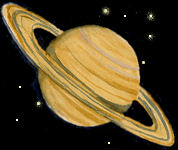
PATRICK I was tempted to put stars behind these paintings, see Saturn, but there was no real reason to do so.
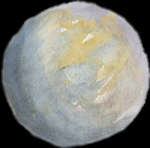
MERCURY (Terrestrial)
Origin of name:- Goes around the sun faster than any other planet, so was named after the messenger of the gods.
Costume accoutrements:- Hat with wings on?
Surface texture:- Solid, mountains, craters. deserts
Moons:- None
Suggested Colour for this Musical:- Grey/yellow
VENUS (Terrestrial)
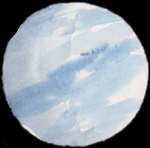
Origin of name:- A very bright, beautiful object in the night sky, so was given the name of the goddess of love. Many areas which have been mapped on the surface have been given female names.
Costume accoutrements:- Cupid's bow and arrow?
Surface texture:- Volcanic plains but some live volcanoes. The whole hidden by clouds of sulphuric acid and carbon dioxide
Moons:- None
Suggested Colour for our musical:-
Blue with dense white
clouds
Odd Fact:- Venus is known as the "Evening star" as it can only be seen in the evening, just after sunset or in the morning before sunrise.
MARS (Terrestrial)
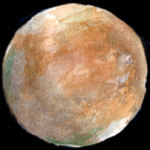
Origin of name:- The god of war
Costume accoutrements:- A sword? Or/and perhaps an imitation armour breast-plate
Surface texture:- Deserts, canyons, polar ice caps, red dust in atmosphere gives the ubiquitous red colour.
Moons:- Two very small ones, -only a few miles across
Suggested Colour:- Red with white poles - and "canals"?
Odd Fact:- From the name Mars comes our month "March"
JUPITER (largest planet in our solar system- All the others would fit together inside)
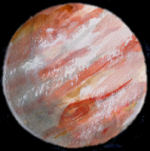
Origin of name:- Jupiter is so called because
of its large size. Roman’s named the planet after their chief
god Jupiter. The god Jupiter is also known as Zeus. .
Costume accoutrements:- Thunder bolts?
Surface texture:- Mainly gas
Moons:- 16 (63)
Suggested Colour:- Series of red and black bands. Feature "The Great Red Spot" which is about 40,000 miles across!
Odd Fact:- Jupiter’s moons are named after his many female 'Lady friends' and their children! (all 63 of them?)
SATURN (New sentences added on 23/8/05)
Origin of name:- When it was named it was the most distant planet known, so was given the name of the father of the gods. NEW Saturn is the god of the harvest and credited with the introduction of agriculture.
Costume accoutrements:- NEW A cardboard sickle?
Surface texture:- Gas
Moons:- 18 (35)
Suggested colour:- Beige with some bands
Odd Fact:- From the name Saturn comes "Saturday"
NEPTUNE
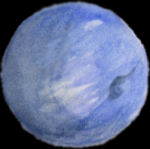
Origin of name:- Discovered in 1846 and called Neptune, the god of the sea, after its blue/green colour.
Costume accoutrements:- Appliqued waves? Or perhaps a trident slung across the shoulders,
Surface texture:- Gas
Moons:- Eight (17) including one, Triton, which goes in the opposite direction to the rotation of Neptune.
Suggested Colour:- Blue/green with the "Great Dark Spot" which is about the size of our Earth.
Odd Fact:- The Hubble Space Telescope could not find the "Great Dark Spot" in 1994, although a space craft saw it several years earlier.
PLUTO (As far as we know is the most distant planet from the sun.)
Origin of name:- Thousands of people suggested various names when it was discovered in 1930, but the winner, who put forward the name Pluto, was an 11 year old school girl from Oxford.
Costume accoutrements:- Headress of plastic icicles
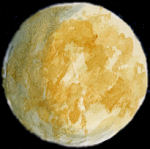
Surface texture:- Water and ice. It is the coldest planet.
Moons:- One
Suggested Colour:- Grey with dark grey splodges.
Odd fact:- Pluto was only discovered because stars went "out" at times and it was realised this undiscovered planet was crossing in front of them. Which is one of the reasons why the name is so apt. - Pluto was the Greek god of the Underworld who was able to make himself invisible.
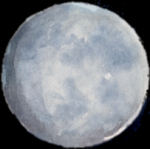
Our MOON- THIS IS NOT A PLANET
Costume accoutrements:- Silver bow and arrow across the back?
Surface texture:- Craters, plains (a bit like here really but without the grass!)
Suggested Colour:- Moon colour!
Odd Facts:- The moon is not a planet, although ancient
astronomers described it as such when they thought the known planets of
the time, and the moon, all revolved around the earth.
Selenography is the study of the moon's surface.
Want to know more about the stars and planets? Here is an excellent site which attempts to answer many astronomical questions in a clear, concise and simple manner.
http://curious.astro.cornell.edu/index.php
The BBC is not responsible for information given on other web sites.