This
page was last updated on |
24-Jul-2005
|
Annlaug, This is written in the first person, Feel free to change. Just like you have targeted the glossary for a more general view of theatrical productions, so I have done likewise here. Of course feel free to sub down.
NEW CARTOONS ADDED. Some of these (the ones without any written text) can be made to face the opposite direction. Or if you are really keen to have some facing a different way, I can redraw them.
Brian
The Role of the Stage Manager (SM) in Amateur Theatre
This article is devoted solely to the amateur stage and even then the role of the SM differs from company to company in the amateur theatre world . Whereas in the professional theatre the SM’s position is clearly defined and structured, it’s safe to say that as various companies have grown, so the tasks of their Stage Manager in that particular group has evolved too, with each company having different requirements. So here's a very general examination of possible tasks.
One theme is common to all SM’s - The Stage Manager is in charge of all things technical in the theatre. “In charge” is an emotive term, ‘Team leader’ or ‘Co-ordinator’ might be a better phrase. Or to use the word in the job description… ‘Manager’. And when the performance is actually underway, then what about "Ringmaster"?
I shall use bullet points to cut down on the waffle and assume you, the reader, is the SM. Lets follow a production through and start a check list...
PRODUCTION MEETINGS
- How is the scenery to be assembled and held in position?
- Times available between scenes to change scenery?
- Any front cloth scenes to help these changes?
- Very approximate durations of scenes? Short or long?
- Dates of performances?
It's quite likely you won't have definite answers at this stage but at least you will get a feel of the complexity or otherwise of the production.
THE REHEARSALS
|
|
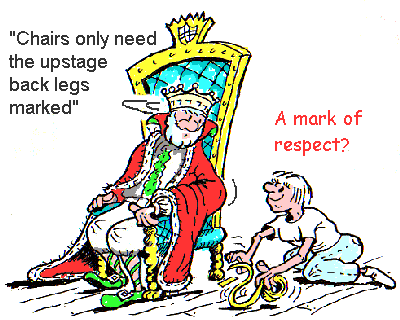
It is normal for the SM to mark out the stage on the rehearsal floor. But use masking tape - chalks rub off. Also mark entrances/exits and positions of furniture. In the rehearsal room, chairs only need the upstage back legs marked. (and that applies to marking the stage floor too) |
 |
Annlaug this is a smaller version, but it's too hard to 'read'.
NEARING PERFORMANCE DAY
- Date of “Get in”?
- Date of “Technical Rehearsal”
- Date of “Dress Rehearsal?
THE GET IN (and GET OUT afterwards)
|
 |
| ...I
HAVE THE KEY" |
- How near can you get the lorry which is carrying the scenery?
- Are there gates/doors which need unlocked and who has the keys?
- What help will you have moving the scenery off the lorry?
- And will the same crew be available when the time comes to get the scenery out of the venue afterwards? (Now that's a task which demands real dedication. For whilst you are all busy moving scenery, the rest of the cast are off to the 'after-show party')
PREPARING THE STAGE
Once all the scenery is at the venue, then it's time to sort it out, try out positions, ensure everything fits together, and most important of all - check those sight lines. Can everyone in the auditorium see the important parts of the set? This is normally done with a helper sitting in the extreme seats shouting instructions to the stage team to move flats/wings/curtains so that a/ they can be seen and b/ they mask the back stage area. If you, as SM, are on stage involved in this operation then go backstage and see if there are any points where you can still see the auditorium seats. Once masking and sight lines are established, then mark the floor where the scenery stands.
THE TECHNICAL REHEARSAL
One question to resolve early on in setting up the backstage crew. Who is to be responsible for the stage furniture- Props or the Scene Shifters?
The technical rehearsal is where it all comes together and cast and backstage
crew iron out the mechanics of the production.
This is your chance as SM to muster your troops. Stress to the Producer
and cast that this rehearsal is for the backstage people. It is NOT a
rehearsal for the cast. Point out that the cast has probably been rehearsing
for many weeks to get their side of the production honed and now it's
the turn of the backstage people to rehearse. (only they haven't had the
luxury of such a long rehearsal period).
For this rehearsal the cast are there to help the backstage production,
so warn them to be prepared to rehearse their cues (say for the end of
a scene) not for their benefit but for you and your crew.
The reason I am so adamant about this, is because time and again I have
discovered that as soon as a producer gets his cast on the stage, s/he
can't help themselves but fall back into rehearsing and before you know
where you are you have another full blown cast rehearsal on your hands,
to such an extent that they look quite askance when asked to redo something
for the sake of the stage staff.
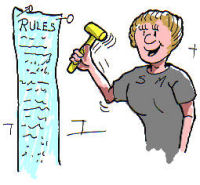 |
Incidentally, if the Producer asks for something to be repositioned, say a chair in which an actor is sitting, the Producer must tell the Stage Manager who in turn tells Props who move the chair into the new position. Not the actor who is sitting in the thing. Doing it the 'official' way may seem a bit like the old Trade Union attitude (That's not my job), but correctly done, everyone who needs to know is aware of the change and can alter their plots/books accordingly. |

I shall digress and tell you a little tale.
During a technical rehearsal I was sitting 'out front' watching the performance.
Beside me sat the choreographer. On stage 'Cinderella' leaves her basket
DSR (Down stage right) and runs off in tears as the curtain slowly and
majestically closes. But it got caught on the basket and halts. Whereupon
the choreographer leaps from her seat in the auditorium, dashes up to
the stage and pushes the basket further upstage, then returns to her seat
with a self satisfied smile. Trouble was - she didn't tell anyone, and
no-one was aware of the problem. It was resolved by someone else telling
the Stage Manager of the difficulty and 'Cinders' was duly shown a new
position for the basket.
Moral? Stick to your own tasks.
THE DRESS REHEARSAL
When a scene has been changed and is being played, go into the auditorium and check all is well on the stage from the audiences' point of view. Also sit in the extreme seats and check sight lines. It’s a good idea to encourage the rest of the back-stage production crew to see the show from the auditorium too, as they won’t be able to during the performance. They too will want to see their handiwork, - props, costumes, make-up etc, in action.
Once all the rehearsals are over and the performances commence then the Producer/Director has finished their work and more often than not goes home, only to return on the “last night” to receive the thunderous applause from the enraptured audience. And if the Producer does not go home, in amateur circles they quite often stay to help out in other ways. I know of one who goes “on the curtain” and another who plays guitar in the show’s orchestra.
So when the Producer leaves, the whole production becomes the responsibility of the Stage Manager. So let’s look at a typical performance.
You will inevitably be the first to arrive and the last to leave.
Clothes? You and all back-stage crew ideally in black. Some companies have black shirts emblazoned with the show’s title on the back.
|
 |
NO IT'S
NOT A CAR BOOT SALE |
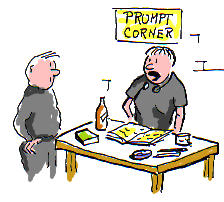
On the wall, near the stage, paste up the scene layouts so that all your team can see them without having to constantly keeping asking you what is next. It also gives them a feel of being more involved too. On those layout sheets also put the duration of the scene and the out cue. For interest it’s fun to put how long it took last time to change that scene too. A time which every one strives to shorten at each change.
Do you know where the nearest fire extinguishers are? Too far away? Bring them nearer. Does your backstage crew know where they are and how to use them?
Have a torch always to hand in your pocket or hanging from your belt.
Have you got your communications headset (If available) and are the batteries charged/renewed?
Test them to the others
Brush the stage. One pundit suggests “No stage is ready until the SM has walked barefoot over the whole acting area“. You’d be surprised how much debris is left behind after the previous night- feathers from boas, hair clips, staples from flats. And of course dust.
Who is doing “call boy” or can you call them via a microphone on your desk? Or are you doing the job yourself. Whatever chosen method, it is your job to warn the cast, (yourself or the call boy/girl) normally at the half hour before the show, fifteen minutes, then three minutes. And of course if it is a big scale performance then, once the orchestra has left the band room the shout is "Overture and beginners please"
NEARING THE PERFORMANCE TIME.
Go on the stage on your own and check that everything is in place where it should be, with furniture and flats on their marks and the set dressed as required.
If there is an apron then check there is nothing untoward left there and what should be there is there. Do this well before the audience arrives. It's very unprofessional for them to see someone wandering about the stage before “curtain up”
This checking is even more important if the performance starts with the curtain already open.
Once you are satisfied that all is well and all the checks have been done with the other departments, then it is your position as SM to alert Front of House staff that (at a pre-arranged time) they can let the audience in to the auditorium.
| It is the SM’s responsibility to stop the cast going
on the stage before the show starts and, worse still, looking through
the main curtains at the audience. In one school production, which
I stage manage, I allow “Only those under 12” to take a peek at the
audience from a curtained area well to the side of the stage. I try
to instill in the youngsters the “magic” of that main curtain divide
between stage and audience and not to break that spell. No-one in
make-up or costume for instance to mingle with the audience until
after the show. Children in school productions love to parade their
stage persona to parents and friends, I guess subconsciously wanting
to break that magic divide by doing so. But let them go home in their make-up- they love that. |
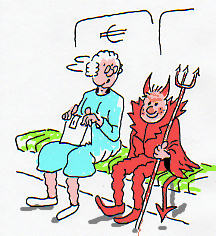 |
| LET
THEM GO HOME IN THEIR MAKE-UP, THEY LOVE THAT |
JUST PRIOR TO CURTAIN UP.
- Someone? You? The School Principal? Usually makes a public announcement to the audience.
- How does Sound know when you are ready to use the off stage mic? Of
course if the announcement is made from the stage then Sound should
see that.
The announcement will probably include some/all of the following points...
- Describe position of emergency exits,
- No smoking
- The interval will last for fifteen minutes and a bell will sound to tell you the second act is about to start.
- No photography?
- Or (if it's a children's performance) ...Does anyone mind if members of the audience take photos of their children appearing in the show? (What a PC world we live in now-a-days?)
So we have arrived... the scenery is in place;
the rest of the flats stacked up in order off stage; required props on
stage and the set dressed, Now, and only now, do you let the cast onto
the stage. (The ones who are 'discovered' when the curtains open.)
Time to cue the music, sound, lights and curtain.
WHEN THE PERFORMANCE IS UNDERWAY
It’s your task to ensure the cast keep quiet in the wings. I came across a great device in a school the other day. It was a box with traffic lights on the front. The box was set to detect sound levels in the area and the lights would change depending upon how loud the chatter was around it. 'Might get one for the next performance!
However you have to be reasonable over gossiping in the wings. With amateurs they are all 'worked up' and excited at the prospect of performing, and also want to hear how that particular part of the show- which caused so much angst in rehearsal - actually goes on the night. So keep the noise down but don’t be too grumpy. (Other SMs will probably have a fit when they read that). Remember these things are also a social occasion, so if they insist on chatting, push your cast further away from the stage . In one school I put a length of masking tape on the corridor floor leading to the stage. This I call my “Whisper Tape” and once passed that tape they are only allowed to whisper.
By the way keep the actors back from the wings even if they are about to make an entrance. So often, when sitting in the audience, you see, not necessarily the actors faces, but perhaps a sleeve or trouser leg fiddling about in the wings, just out the corner of your eye, which is very distracting. Explain to the actors if, whilst standing in the wings, they can see anyone in the audience, then they can see you.
It is usually the SM's task to work the Spot Fx off stage too - the knock on the door etc.
SCENE CHANGES
On a small stage, where space and access is limited, to save any bottlenecks when a scene finishes and you need to set the next one, it is best to stick to the following order...
- Scene ends. Curtains (if any) close. Actors come off the stage, - possibly carrying some of the smaller props. This needs rehearsing, especially if the scene ends in a blackout.
- Props go onto the stage and bring their properties off. Then once they are clear...
- Scene shifters go onstage and remove (strike) the scenery from the previous scene.
- Scene shifters then set the next scene. Once they have finished they come off and...
- Props go back on stage and dress the new set.
- Finally the SM goes on stage on their own and checks all is well.
- SM comes off stage and tells the cast members waiting to go on, that the stage is "theirs" and they can take their places on the stage, which they do.
- Once SM is satisfied they are in place, SM cues music, lights, sound and curtain.
Of course things are slightly amended if there is a front-cloth being played out during this scene change. And if it's a fill-in cabaret act there to amuse the audience whilst the scenery is being changed, how will they be told when you are ready?
Every one must stick to their own task during these changes. Only help another department if help is requested. Trying to be helpful and placing a chair in the wrong position is not helpful and only means Props have to check it, so they might as well have done it in the first place.
THE INTERVAL
You to time the interval (I always forget to start my stopwatch) and ring the bell to summon the audience back? Who is going to tell you the queue has finished at the snack bar?
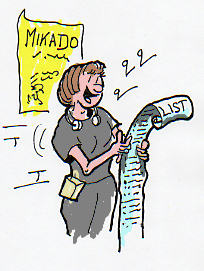 |
And that's all there is to it! A position which needs organisational, patience and "people" skills, but very satisfying when everything runs smoothly. Oh yes and an inveterate maker of lists. Enjoy Brian Willis |
| "... I'VE GOT A LITTLE LIST..." |